



If you're new here, you may want to subscribe to my RSS feed. Thanks for visiting!
What is Time Of Use (TOU) Metering (Smart Meters)?
TOU is an electricity billing system that relates the cost of using a kilowatt hour (kwh) dependent on the time of day that kilowatt hour is consumed. During “peak” periods when the electrical grid is under high demand the electricity consumer will pay more for a kwh than they would during off peak periods when there is less stress on the grid. Special meters have been developed called “Smart Readers” to calculate this increasingly complex method of billing.
Between now and 2025, Ontario must build almost a whole new electricity system. This includes replacing about 80 per cent of our current generating facilities are retired over time, and expanding the system to meet future growth. Building new supply is vital. So is conservation. That’s why the Government of Ontario is introducing new tools like smart meters that will encourage all of us to think more about how and when we use electricity.
Smart meters measure hourly electricity use, so electricity prices can be different at different hours of the day. That better matches the way prices work in the electricity market, and will encourage us to think more about how and when we use electricity. As we move consumption away from the more expensive (peak) times of the day, we can help Ontario reduce its peak demand, which can help limit the building and operation of peak generating facilities.
Why TOU and Smart Readers?
Supplying electricity at peak times (those times when we’re all using a lot of electricity) has a range of impacts:
- It adds to our electricity costs because higher demand often means higher market prices.
- It’s hard on the environment because more of the less attractive forms of generation must be run to meet them.
- It adds to the amount that Ontario needs to invest in the system because meeting the peaks means building even more new generating facilities, and more transmission and distribution infrastructure and that also adds to electricity costs.
High demand peaks affect the power system in three ways:
- They strain the power system. Particularly during sustained heat-waves, power generators work at almost full capacity.
- High demand pushes up the cost to produce electricity. At peak, more expensive types of electricity production are called upon.
- Peak demand forecasts are used by power system planners to determine how much more power production the province will need in the years ahead. The higher the demand peaks, the more investment will be needed in the electricity system - building new generation plants, new transmission and distribution infrastructure.
The real impacts of heavy drain on the grid were displayed in 2006 when a massive heatwave hit North America which sadly resulted in 225 deaths. As people cranked their air conditioning the grid system could not supply the electricity demand and “brownouts” rolled through cities, provinces and states. The Ontario government believes (is hoping) that by altering how electricity is billed based on TOU, people will adjust their energy usage habits in order to save money on their power bills. All of this makes logical sense, however, as implemented today it isn’t really working.
What are Smart Readers?
A smart meter tracks how much electricity you use and when you use it, providing key information to help you manage your electricity costs. A smart meter looks like the meter you have now, except the display is digital and there are no dials. It records how much electricity was used and when it was used (typically hourly) and communicates this information automatically via wireless and other technologies. A smart meter electronically tracks how much electricity is used and when it is used, paving the way for time-of-use pricing.
How much will electricity cost?
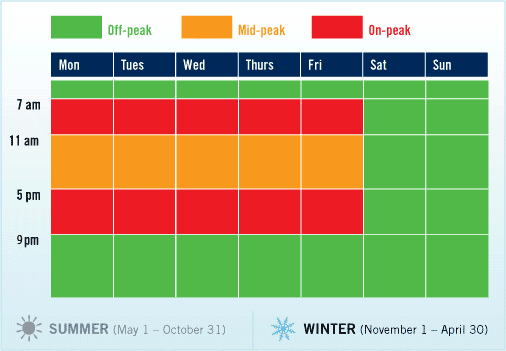 The TOU will change how Ontarians pay for electricity consumption. Some centres, like the Greater Toronto Area have already phased TOU and Smart Meters into their customers daily lives. The costs for electricity depend on the season, day of the week and time of day. The charts below show what a consumer will pay per kwh. As Ontario is the first province to introduce TOU rates, Premier McGuinty has admitted that the incentives to use off peak times are too low. In addition, as you will see in the pricing below, the “On Peak” rates are almost double what Ontarians pay (or paid) prior to the TOU rates.
The current pricing for TOU is as follows:
| Summer Weekdays | Winter Weekdays | ||||
| May 1 - October 31 | November 1 to April 30 | ||||
| Time | Period | ¢/kWh | Time | Period | ¢/kWh |
| 7 am to 11 am | Mid-Peak | 8.1 | 7 am to 11 am | On-Peak | 9.9 |
| 11 am to 5 pm | On-Peak | 9.9 | 11 am to 5 pm | Mid-Peak | 8.1 |
| 5 pm to 9 pm | Mid-Peak | 8.1 | 5 pm to 9 pm | On-Peak | 9.9 |
| 9 pm to 7 am | Off-Peak | 5.1 | 9 pm to 7 am | Off-Peak | 5.1 |
| Weekends & Holidays | Weekends & Holidays | ||||
| All day | Off-Peak | 5.1 | All day | Off-Peak | 5.1 |
Our Situation
As mentioned in Our ecoEnergy Retrofit, we will be changing all of our lightbulbs from incandescent to CFL bulbs. With TOU it is likely we would probably stand to save even more than the $150 a year we determined a household would save by switching to CFL bulbs. We also have a room that has electric baseboard heat and these HAVE TO GO. We will get a natural gas fireplace to heat that space. In addition we will follow many of the tips in the next section. We will also get rid of our electric hot water heater and replace it with a natural gas model - no electric charges and we won’t be renting any longer.
Strategies to Reduce Electricity Use
- Cut your air conditioning costs. Making wise use of your air conditioner will have the biggest impact on your summer energy bill. Set your air conditioner a few degrees higher than you normally would, and turn it off when no-one is home. You can also help your air conditioner work more efficiently:
- Replace or clean the filters once a month.
- Use a ceiling fan to circulate the cold air. This will allow you to raise the thermostat setting by a few degrees without a noticeable difference.
- Close shades and curtains on the sunny side of the house.
- Clothes dryers consume a lot of energy. Wait until evening or the weekend and you’ll pay a third of the cost.
- Electric water heaters can really make electricity use spike as they refill and heat water. If you reduce the amount of hot water you use during peak periods, you also reduce the amount of electricity you use during these times. Get the utility company to reduce the heat of the heater. Although some manufacturers set water heater thermostats at 140ºF, most households usually only require them set at 120ºF and by dropping by 20ºF you can save 6-10% in your electrical bill.
- If you have a pool, run your pump and heater during off-peak hours. You may only need to run your pump for six or eight hours a day.
- Your electric stove is also a high energy user – but there are a lot of simple ways you can minimize these costs at peak times:
- Match the pots to the element size, make sure the bottoms of your pans are flat and put the lids on.
- Minimize the pre-heating time for your oven. Unless you are baking, you may not even need to pre-heat.
- Better yet, use a crock pot, toaster oven or a small microwave – you’ll use less energy, and you won’t be creating extra heat in the house on hot days.
- Do laundry on weekends and wash in cold water.
- Turn the dishwasher on after 9 p.m. and select the economy setting and air dry cycle.
- Set the air-conditioning a few degrees warmer during the afternoon. We don’t have central air so we’ll run the window unit before bed - after 9pm.
- Turn appliances such as the computer, radio and TV off when they’re not in use.
- Most common but sometimes forgotten, turn lights off when not in us.
- Turn your computer monitor off if you are not going to use it for 20 minutes, and turn your computer off if you’re not going to use it in the next two hours.
- Fix water leaks and drafts, clean filters on air conditioners and furnaces and generally keep your appliances in good working order.
- Buy Energy Star rated products for your home. Switching to the most energy-efficient products can save you hundreds of dollars in energy costs.
- The average Canadian home has 25 electronic devices that use standby power which can add up to 10 per cent of household electricity consumption. Plug these devices (TVs, VCRs, etc..) into a power bar, which cuts off the supply of electricity.
Smart Meter Results to Date
The results to date have not been good and are proving to be a political land mine for the Premier. According to data released, 68 per cent of 10,000 tracked Toronto Hydro customers had higher bills in the first year of the new program. The government will state that this is due to people not changing their energy usage habits but their NDP and Conservative critics are calling the TOU rates an electricity tax grab which has hit Ontarians very hard when considering the HST tax has been added to bills as well. Bills are going up and the conservation reduction is not occurring. People are using off peak times and not seeing the savings on their bills. At this point I would have to agree that the program, which cost Ontarians $2 billion dollars, is failing and must be altered very soon.


Wow! Thanks for posting such a comprehensive review of these things. I dont have one yet :( but I’m hoping that I will get one soon (I think my utility is upgrading). I’ll have to remember to come back when they do!
[...] it!Other Articles You May Enjoy:Our New Center Point Smart Meter: Will it Really Save us Money? Smart Meters: Time of Use (TOU) Metering Turns Out Duct Tape Cannot Fix Everything: Things I Learned During our Free Energy Audit The Cost [...]
Twitter: InvestItWisely
P.S. switching to natural gas may be a smart way to go, but I have a personal fear of a natural gas explosion from watching too many movies and TV shows where that has happened. ;)
Twitter: InvestItWisely
If TOUs are based on actual supply & demand they can be a smart way to go. They should also change billing practices to use volt-amperes (I think that is the measurement) instead of watts so that you CFL users pay for the true cost of your energy consumption. ;)
They could apply the same concepts to the highways as well to cut down on peak congestion and internalize some of the costs of driving that are currently externalized or paid indirectly via other means.
Twitter: SustainablePF
I need to look into this a bit more (the volt-amperes).
We have no issue w/ TOU but things have to make sense (and cents). The rates are not properly set, the meters are proven to not work properly and this is a political land mine for the party in power in Ontario.
Some excellent points made, I switched back to an electric clothes dryer, and I am now regretting that move. If I had stayed with Natural Gas, even with it’s price going up it would be cheaper than the price Hydro is now charging.
Twitter: SustainablePF
I’d hope TOU rates would mean post 9pm would be lower charges but the off times need to see lower rates, and, the “smart” meters need to actually work properly.
and putting a blanket around our electric water heater helps to prevent some of the heat loss. excellent post!
Twitter: SustainablePF
Ah yes! I forgot that one. We bought a blanket last week and need to get it onto our hot water heater pronto!