


If you're new here, you may want to subscribe to my RSS feed. Thanks for visiting!
 As part of our ecoEnergy Retrofit we will replace all of the incandescent bulbs the previous owners had installed. Upgrading light bulbs is not covered by the ecoEnergy Retrofit program, however, we recognize that upgrading to compact fluorescent lights (CFL) or even LED (light-emitting diode) light bulbs will save us money. Our personal and financial philosophy dictates that we try to save money and leave a smaller carbon footprint whenever it makes sense to do so. When it comes to electricity usage we recognize there are many ways to reduce our bills and keep our money in our pockets while acting green. Seems like a no brainer to us.
So why chose CFL lightbulbs? An ENERGY STAR Qualified Compact Fluorescent Light bulb (CFL):
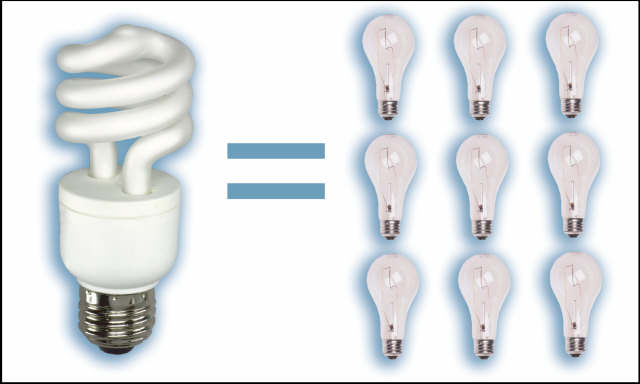
- The average rated life of a CFL is between 8 and 15 times that of incandescents. CFLs typically have a rated lifespan of between 6,000 and 15,000 hours, whereas incandescent lamps are usually manufactured to have a lifespan of 750 hours or 1,000 hours. You will buy less bulbs and produce less waste.
- can save more than $40 in electricity costs over its lifetime
- uses about 75% less energy than standard incandescent bulbs and lasts up to 10 times longer
- produces about 75% less heat, so it’s safer to operate and can cut energy costs associated with home cooling
From my research lighting accounts for between 9% and 15% of all residential electricity consumption. An average Canadian home has 30 light fixtures, indoors and out, that consume close to $200 of electricity every year. CFL lightbulbs use 75% less power and would then consume about $50 per year.
Using the conservative light span of 8 years for CFL lightbulbs we can continue the financial argument to using CFL bulbs by comparing the two types of bulbs directly.
13w CFL bulb |
60w Incandescent Bulb | |
| Cost to Purchase 1 | $1.50 | $0.50 |
| Buy in Next 8 Yrs | 1 | 16 |
| Total Purchase Cost | $1.50 | $8.00 |
| Electricity Cost | $400.00 | $1,600.00 |
| Total Cost over 5YR | $401.15 | $1,608.00 |
Switching to CFLs will save you over $1200 over the next 8 years. From a financial perspective there is really no argument to not make the switch. If you dispose of the bulbs properly (recycle! but make sure you do it properly, most Blue Box programs don’t take them, but The Home Depot does), from a sustainability perspective you will produce much less waste than using traditional bulbs and far fewer bulbs will be produced which will reduce manufacturing waste.


[...] MonthPrairie EcoThrifter | Creating Wealth With What You Already HaveSustainable Personal Finance | Don’t Lighten Your Wallet with Inefficient BulbsInvestingOblivious Investor | 401k Rollover: Where, Why, and HowGeneration X Finance | The Lost [...]
Thanks for crunching the actual numbers :).
This is our plan Forest. To not just put the ideological chit chat out there, but to back the concepts/practices up with real numbers that pertain to PF.
[...] Don’t lighten your wallet with inefficient bulbs (Sustainable Personal Finance) [...]
[...] ROOTING for inflation.”FrugalitySustainable PF at Sustainable Personal Finance presents Don’t lighten your wallet with inefficient bulbs, saying “When it comes to electricity usage we recognize there are many ways to reduce our [...]
Interesting, a lot of savings here!
Kevin (Invest it Wisely) and I had some interesting discussion about these bulbs a while back. They may not be as sustainable as they claim as they have dangerous powder inside and are more expensive to produce in the first place. When LED lighting gets to a good enough level for indoor use that is when things will be a lot more environmentally friendly.
The magnesium, as I mentioned, is much less than you will find in old thermostats. Disposed of properly (at the box store mentioned) and the magnesium gets re-used in subsequent bulbs. Yes, more expensive to produce and the price reflects that. The number crunching we did shows that you will still spend much more on 10 incandescent bulbs than 1 CFL, plus you will use much more power. Agreed on the LED lighting! It is very expensive right now however.
Nice article! The only problem I have with these bulbs is how to dispose of them. We can’t just throw them in the garbage. How many people are going to save them and take them to the dump?
Hi Angela,
The Home Depot actually has boxes where you can recycle your burnt out bulbs. Not the MOST convenient way to get rid of them, but the option is there to use.
Hello! :) Nice blog- love the idea of sustainability and personal finance.
I’ll make sure to get these eco light bulbs when I get my place!
There are so many reasons to deal with finances in a sustainable manner, and when it makes sense financially to do so everyone wins!