|
|
By Sustainable PF
If you're new here, you may want to subscribe to my RSS feed. Thanks for visiting! What is Time Of Use (TOU) Metering?
TOU is an electricity billing system that relates the cost of using a kilowatt hour (kwh) dependent on the time of day that kilowatt hour is consumed. During “peak” periods when the electrical grid is under high demand the electricity consumer will pay more for a kwh than they would during off peak periods when there is less stress on the grid. Special meters have been developed called “Smart Readers” to calculate this increasingly complex method of billing.
Between now and 2025, Ontario must build almost a whole new electricity system. This includes replacing about 80 per cent of our current generating facilities are retired over time, and expanding the system to meet future growth. Building new supply is vital. So is conservation. That’s why the Government of Ontario is introducing new tools like smart meters that will encourage all of us to think more about how and when we use electricity.
Smart meters measure hourly electricity use, so electricity prices can be different at different hours of the day. That better matches the way prices work in the electricity market, and will encourage us to think more about how and when we use electricity. As we move consumption away from the more expensive (peak) times of the day, we can help Ontario reduce its peak demand, which can help limit the building and operation of peak generating facilities.
Why TOU?
Supplying electricity at peak times (those times when we’re all using a lot of electricity) has a range of impacts:
- It adds to our electricity costs because higher demand often means higher market prices.
- It’s hard on the environment because more of the less attractive forms of generation must be run to meet them.
- It adds to the amount that Ontario needs to invest in the system because meeting the peaks means building even more new generating facilities, and more transmission and distribution infrastructure and that also adds to electricity costs.
High demand peaks affect the power system in three ways:
- They strain the power system. Particularly during sustained heat-waves, power generators work at almost full capacity.
- High demand pushes up the cost to produce electricity. At peak, more expensive types of electricity production are called upon.
- Peak demand forecasts are used by power system planners to determine how much more power production the province will need in the years ahead. The higher the demand peaks, the more investment will be needed in the electricity system - building new generation plants, new transmission and distribution infrastructure.
The real impacts of heavy drain on the grid were displayed in 2006 when a massive heatwave hit North America which sadly resulted in 225 deaths. As people cranked their air conditioning the grid system could not supply the electricity demand and “brownouts” rolled through cities, provinces and states. The Ontario government believes (is hoping) that by altering how electricity is billed based on TOU, people will adjust their energy usage habits in order to save money on their power bills. All of this makes logical sense, however, as implemented today it isn’t really working.
What are Smart Readers?
A smart meter tracks how much electricity you use and when you use it, providing key information to help you manage your electricity costs. A smart meter looks like the meter you have now, except the display is digital and there are no dials. It records how much electricity was used and when it was used (typically hourly) and communicates this information automatically via wireless and other technologies. A smart meter electronically tracks how much electricity is used and when it is used, paving the way for time-of-use pricing.
How much will electricity cost?
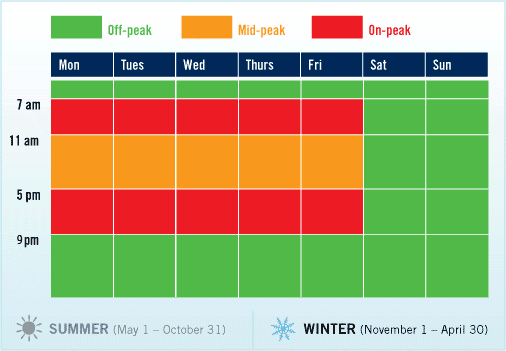 The TOU will change how Ontarians pay for electricity consumption. Some centres, like the Greater Toronto Area have already phased TOU and Smart Meters into their customers daily lives. The costs for electricity depend on the season, day of the week and time of day. The charts below show what a consumer will pay per kwh. As Ontario is the first province to introduce TOU rates, Premier McGuinty has admitted that the incentives to use off peak times are too low. In addition, as you will see in the pricing below, the “On Peak” rates are almost double what Ontarians pay (or paid) prior to the TOU rates. The TOU will change how Ontarians pay for electricity consumption. Some centres, like the Greater Toronto Area have already phased TOU and Smart Meters into their customers daily lives. The costs for electricity depend on the season, day of the week and time of day. The charts below show what a consumer will pay per kwh. As Ontario is the first province to introduce TOU rates, Premier McGuinty has admitted that the incentives to use off peak times are too low. In addition, as you will see in the pricing below, the “On Peak” rates are almost double what Ontarians pay (or paid) prior to the TOU rates.
The current pricing for TOU is as follows:
| Summer Weekdays |
|
|
Winter Weekdays |
|
|
| May 1 - October 31 |
|
|
November 1 to April 30 |
|
|
|
|
|
|
|
|
| Time |
Period |
¢/kWh |
Time |
Period |
¢/kWh |
| 7 am to 11 am |
Mid-Peak |
8.1 |
7 am to 11 am |
On-Peak |
9.9 |
| 11 am to 5 pm |
On-Peak |
9.9 |
11 am to 5 pm |
Mid-Peak |
8.1 |
| 5 pm to 9 pm |
Mid-Peak |
8.1 |
5 pm to 9 pm |
On-Peak |
9.9 |
| 9 pm to 7 am |
Off-Peak |
5.1 |
9 pm to 7 am |
Off-Peak |
5.1 |
|
|
|
|
|
|
| Weekends & Holidays |
|
|
Weekends & Holidays |
|
|
| All day |
Off-Peak |
5.1 |
All day |
Off-Peak |
5.1 |
Our Situation
As mentioned in Our ecoEnergy Retrofit, we will be changing all of our lightbulbs from incandescents to CFL bulbs. With TOU it is likely we would probably stand to save even more than the $150 a year we determined a household would save by switching to CFL bulbs. We also have a room that has electric baseboard heat and these HAVE TO GO. We will get a natural gas fireplace to heat that space. In addition we will follow many of the tips in the next section. We will also get rid of our electric hot water heater and replace it with a natural gas model - no electric charges and we won’t be renting any longer.
Strategies to Reduce Electricity Use
- Cut your air conditioning costs. Making wise use of your air conditioner will have the biggest impact on your summer energy bill. Set your air conditioner a few degrees higher than you normally would, and turn it off when no-one is home. You can also help your air conditioner work more efficiently:
- Replace or clean the filters once a month.
- Use a ceiling fan to circulate the cold air. This will allow you to raise the thermostat setting by a few degrees without a noticeable difference.
- Close shades and curtains on the sunny side of the house.
- Clothes dryers consume a lot of energy. Wait until evening or the weekend and you’ll pay a third of the cost.
- Electric water heaters can really make electricity use spike as they refill and heat water. If you reduce the amount of hot water you use during peak periods, you also reduce the amount of electricity you use during these times. Get the utility company to reduce the heat of the heater. Although some manufacturers set water heater thermostats at 140ºF, most households usually only require them set at 120ºF and by dropping by 20ºF you can save 6-10% in your electrical bill.
- If you have a pool, run your pump and heater during off-peak hours. You may only need to run your pump for six or eight hours a day.
- Your electric stove is also a high energy user – but there are a lot of simple ways you can minimize these costs at peak times:
- Match the pots to the element size, make sure the bottoms of your pans are flat and put the lids on.
- Minimize the pre-heating time for your oven. Unless you are baking, you may not even need to pre-heat.
- Better yet, use a crock pot, toaster oven or a small microwave – you’ll use less energy, and you won’t be creating extra heat in the house on hot days.
- Do laundry on weekends and wash in cold water.
- Turn the dishwasher on after 9 p.m. and select the economy setting and air dry cycle.
- Set the air-conditioning a few degrees warmer during the afternoon. We don’t have central air so we’ll run the window unit before bed - after 9pm.
- Turn appliances such as the computer, radio and TV off when they’re not in use.
- Most common but sometimes forgotten, turn lights off when not in us.
- Turn your computer monitor off if you are not going to use it for 20 minutes, and turn your computer off if you’re not going to use it in the next two hours.
- Fix water leaks and drafts, clean filters on air conditioners and furnaces and generally keep your appliances in good working order.
- Buy Energy Star rated products for your home. Switching to the most energy-efficient products can save you hundreds of dollars in energy costs.
- The average Canadian home has 25 electronic devices that use standby power which can add up to 10 per cent of household electricity consumption. Plug these devices (TVs, VCRs, etc..) into a power bar, which cuts off the supply of electricity.
Results to Date
The results to date have not been good and are proving to be a political land mine for the Premier. According to data released, 68 per cent of 10,000 tracked Toronto Hydro customers had higher bills in the first year of the new program. The government will state that this is due to people not changing their energy usage habits but their NDP and Conservative critics are calling the TOU rates an electricity tax grab which has hit Ontarians very hard when considering the HST tax has been added to bills as well. Bills are going up and the conservation reduction is not occurring. People are using off peak times and not seeing the savings on their bills. At this point I would have to agree that the program, which cost Ontarians $2 billion dollars, is failing and must be altered very soon.
Google's PowerMeter: Measuring Our Electricity Consumption Via The Internet. Review: Green Design: A Healthy Home Handbook by Alan Berman Diesel Electric Hybrid Vehicles: An Evolution in Hybrid Vehicles
By Sustainable PF
In September 2010 we moved into our new (to us) 100 year old home. We felt it prudent to ask for average utility costs prior to buying and we were taken aback at the heating costs of our soon to be new home. I had done a retrofit on our last home (heating block was cracked in the 25 year old furnace so I wanted to get some money back, wanted to save money on heating and reduce our carbon foot print) and in 2009 our average heating bill was $96 per month (mainly due to a warm winter, as warm as it gets in Ontario in the winter that is). The previous owners of our new home spent $150 a month! We recognized we needed to do something about our heating costs and knowing that the ecoEnergy program was expiring March 31, 2011 we decided to get ours done as soon as possible.
We had the energy inspector come to our house and he fed the data he took into his model. Our house rated a 51 of a possible 100. It is a 100 year old house after all. For comparison sake, in 2011 Ontario building code has a minimum 80 rating for new builds. Our house had 6.4 air changes per hour whereas R-2000 new builds must have a maximum rating of 1.5. Many older homes are 8 to 10 times higher than the R-2000 standard, so our old house was actually sealed pretty well already. Interestingly, the inspector told us that unless we wanted to purchase and install an air exchanger on every floor of our house (we have a natural gas boiler - so no duct work), he would not suggest we partake in any sealing initiatives (caulking, foam inserts in outlets etc) and that insulating our house would be more than enough. The issue he told us was that a house that is too sealed and does not have any air exchangers, mold can become a problem. He suggested we simply crack a window periodically to get some cool air into the house. A few days after the inspection we received his report on what we can do to improve our energy efficiency.
We could upgrade our boiler furnace, but it is only 8 years old so that didn’t make a lot of sense. We passed on this. The windows in our house are all under 7 years old so we wouldn’t be doing this improvement either (the report did not suggest we do either project).
In July of 2010 we bought our home. We knew we were going to do the retrofit and that the city we live in will be metering water in 2011. The toilets (two) in the house are pretty low grade. A box store in town had a sale in July on American Standard low flow toilets so we bought two of them and stored them in the new house prior to our move. These toilets use 4.8 litres per flush whereas “normal” flow toilets use 6 litres per flush. Saving 20% more water, and money, per flush is a good idea. I have yet to install the toilets, but home to do so before Christmas. Costs: Regular Price: $538 + $69.94 HST = 607.94. Our sale cost: $336.74. Savings: $271.20. Retrofit rebate: $130 ($65 per toilet). Total Cost: $206.74 or 66%. Total savings on water usage, unknown.
The most logical way to reduce our heating costs is insulation. Up to 30-45% of the heat lost in a home comes from an uninsulated attic in the winter. Our attic is unfinished (for now) and has 6 inches of cellulose insulation blown into the floor. Not enough! The previous owners had taken the pink fibreglass insulation out of the roof rafters and left it on the floor. We decided to lay it on the floor and found we had gained 6 inches of insulation over about 40% of the attic floor. Knowing we could get $250 in rebates by adding 6 inches of insulation to the attic we decided it was worth buying more. A Canadian box store was selling the insulation for just under $31 for a bag of insulation so I measured the remaining floor space and determined we needed 10 bags to finish the job. The box store had an offer where if you spent $150 on insulation you could mail in for a $25 gift card. So I made two trips so I would get $50 in gift cards, which we will use on other projects in our home. Costs: Insulation $31 x 10 = $310. Rebate $250. Gift Cards $50. Total cost to get our attic RSI value to 7: $10 or 97%. Heat savings, unknown, but that insulation will have paid for itself before winter is done.
Thanks to MDG for his research into heat loss from a basement. 25%-30% heat loss is a lot! We had a choice to have our basement insulated to R20 or R40. We ultimately chose R20 as that is the current building code recommendation. We used soy-based polyurethane foam insulation in the basement headers and on the walls. Costs: $3013.71. Retrofit Rebate: $750. Total Cost: $2263.71 or 75%.
We weren’t done yet! Exterior walls can allow up to 50% of your heat to escape. We had our exterior walls insulated with an environmentally friendly product called airKrete. This product is completely non-toxic, CFC and urea-formaldehyde/ formaldehyde- free and 100% fireproof. Although this product is more expensive than blown in cellulose we chose it for a number of reasons. First, cellulose compacts over time, usually 10-15 years. Why do I bring this up? A few reasons. One we’d have to pay to have the work done again. Another, when insulation is blown into exterior walls many small holes are drilled into the walls and then roughly mudded. This means the home owner has the unenviable task of sanding, cleaning up and re-painting the house. The second reason we chose airKrete is that is an expanding foam that will reach all the nooks and crannies of our old house. Lastly, airKrete has an R value of 16 which bests the 14 R value of cellulose. The contractor who installed the airKrete told us all his customers gain the rebate of $190 by improving the air tightness of their house by 10 percent. For us, this means achieving an air change rate per hour of 5.76 at a pressure of 50 Pa. Cost of Insulation: $6203.70. Retrofit Rebates: $2065. Total Costs: $4138.7 or 67%.
In the end our total bill for our retrofit was: $10135.35. Total Retrofit Rebates: $3195. Total Cost: $6940.70 or 68.5%!
We walk or bike to work, like to shop locally. We used two local non-chain companies for the majority of our retrofit cash outputs into our community. We’ve now balanced (and exceeded) our recent non-local purchase versus the alternatives we have here in Canada. One area Canadians can see big savings on monthly bills and doing the right thing for the environment is to reduce home energy usage waste. There are but a few short months left for Ontarians to get their energy audit done, get the improvements done and the re-test. If you care for the environment, want to save money over time and want to lower that oil/gas bill, do the Retrofit.
Seven Powerful Steps That You Can Use To Save $14,341 in The Next 6 Months Counting Down to Quality Determining Whether Home Improvement Costs are Good or Bad
By Sustainable PF
The ecoEnergy Retrofit Program is (was) a fantastic idea where the Federal and Ontario governments would provide up to $5000 to homeowners who was to make their homes more energy efficient. I say “was” as the Tory government suspended its involvement in March 2010 a full year prior to the planned end of the program (March 31, 2011). Ontario will also end its involvement in the program as scheduled. The program essentially gives rebates to home owners who make their home more energy efficient depending on the things the home owners decide to improve.
There is still time for you to do your own retrofit and its pretty easy to do. First you need to contact a certified energy inspector. The inspection takes about 90 minutes and costs between $300-$350 + HST (Ontario). The government will reimburse you $150 after the test is done. The inspector will provide you with a report that tells you what your current energy rating is. The report also tells you the different improvements you can make with a corresponding rebate you will get for each improvement. You then choose which improvements to make and get them done. You contact the inspector a second time for the follow up test. This costs $150 and you are provided with a new efficiency rating. The inspector then submits your application for the rebates the government will provide.
Some of the upgrades you can make include adding insulation to your walls, basement and attic, replacing your old inefficient furnace with a high efficiency model or even a geo-thermal system, reduce the air/heat loss of your home, replace old windows and/or doors with new ones, install low flow toilets, upgrade your wood stove, upgrade you air conditioner with a hi-eff model and replace your hot water heater with an EnergyStar model.
In Ontario we can still get $5000 worth of rebates on these project which really help off set the costs. When the Feds were matching the $5000 amount many of these improvements were paid for entirely. Unfortunately the program was so wildly popular that the $220 million the Feds set aside for the program ran out. In these tough economic times, and the Progressive Conservative record on green policy, no more funds were added to the program.
Check out our analysis on the improvements we decided to make.
Using a Home Improvement Video to Guide Your Project Home Improvement Tips for Your Home Deduct Home Improvements on Taxes
|
|